

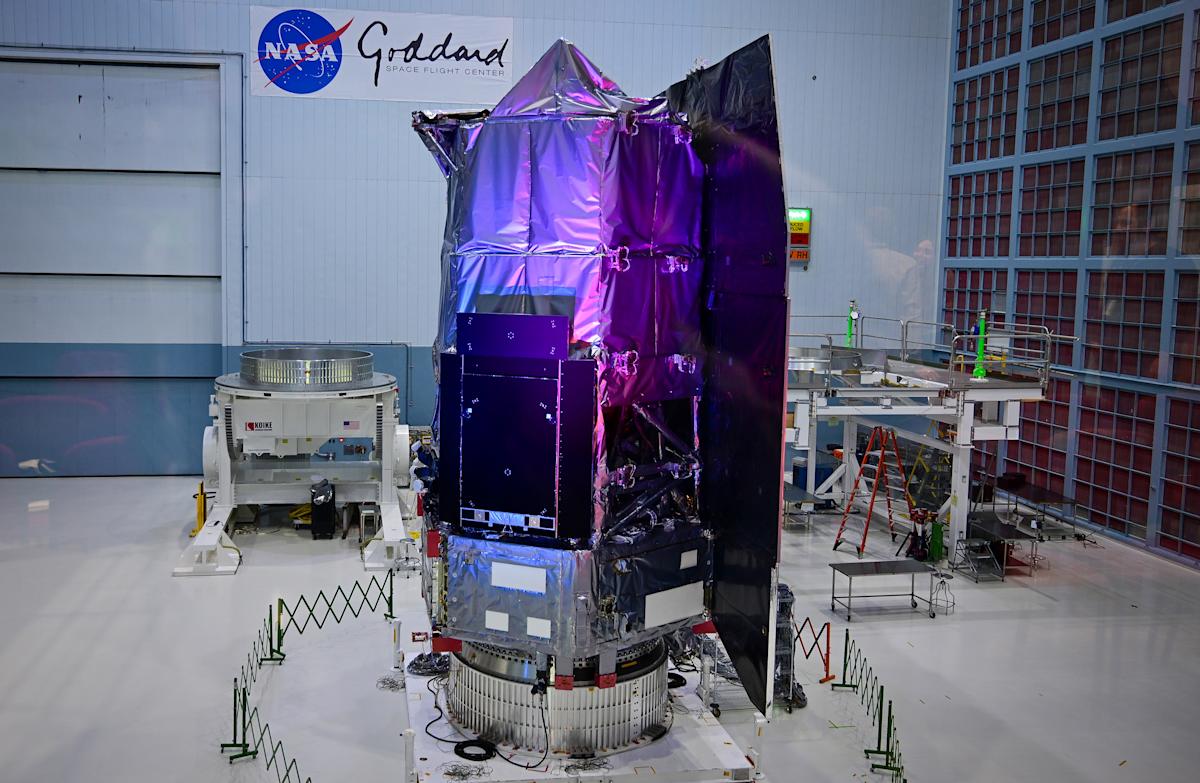
The Roman telescope boasts an expansive field of view, surpassing Hubble’s by a factor of 100.
 Baltimore Sun via Getty Images
NASA is preparing to send its next major cosmic observatory into orbit later this year. According to the agency, the Nancy Grace Roman Space Telescope is scheduled for an early September launch. This new instrument, affectionately called Roman, offers a field of view that is 100 times wider than that of the Hubble Space Telescope.
The early September window represents the earliest possible launch date for Roman. NASA confirmed that the telescope will be launched on a SpaceX Falcon Heavy rocket, with a firm deadline of May 2027 if the initial date is missed.
Named in honor of NASA’s first chief astronomer and the “mother” of Hubble, the Nancy Grace Roman Space Telescope was first proposed in 2016. Originally known as the Wide Field Infrared Survey Telescope (WFIRST), it has undergone significant development. While its primary mirror is comparable in size to Hubble’s, Roman can image areas of the sky that are at least 100 times larger.
 NASA
NASA“Roman will collaborate closely with other NASA observatories like the James Webb Space Telescope and the Chandra X-ray Observatory,” explained Julie McEnery, Roman’s senior project scientist, in 2023. “While those telescopes excel at zooming in on specific, rare transient objects after they are discovered, Roman’s vast field of view will help identify many such objects that were previously unknown. Because no observatory has ever scanned the cosmos in this way before, we may even uncover entirely new types of celestial events and objects.”
Once in orbit, Roman will position itself approximately one million miles from Earth. It will utilize two primary instruments to conduct its research. The first is a 300.8-megapixel camera capable of capturing light from the visible spectrum to near-infrared wavelengths. The second is a high-contrast coronagraph, which will enable the telescope to image exoplanets that would typically be obscured by the brightness of their host stars.
Roman’s primary mission is to address fundamental questions regarding dark energy, exoplanets, and astrophysics. Despite extensive research, astronomers still know surprisingly little about dark energy, which constitutes roughly 68 percent of the universe. Beyond these scientific breakthroughs, Roman is also expected to deliver stunning, high-resolution images of our universe.
- Privacy Dashboard
- About our ads